GOLF CLUB SOUFFLENHEIM

18-hole course

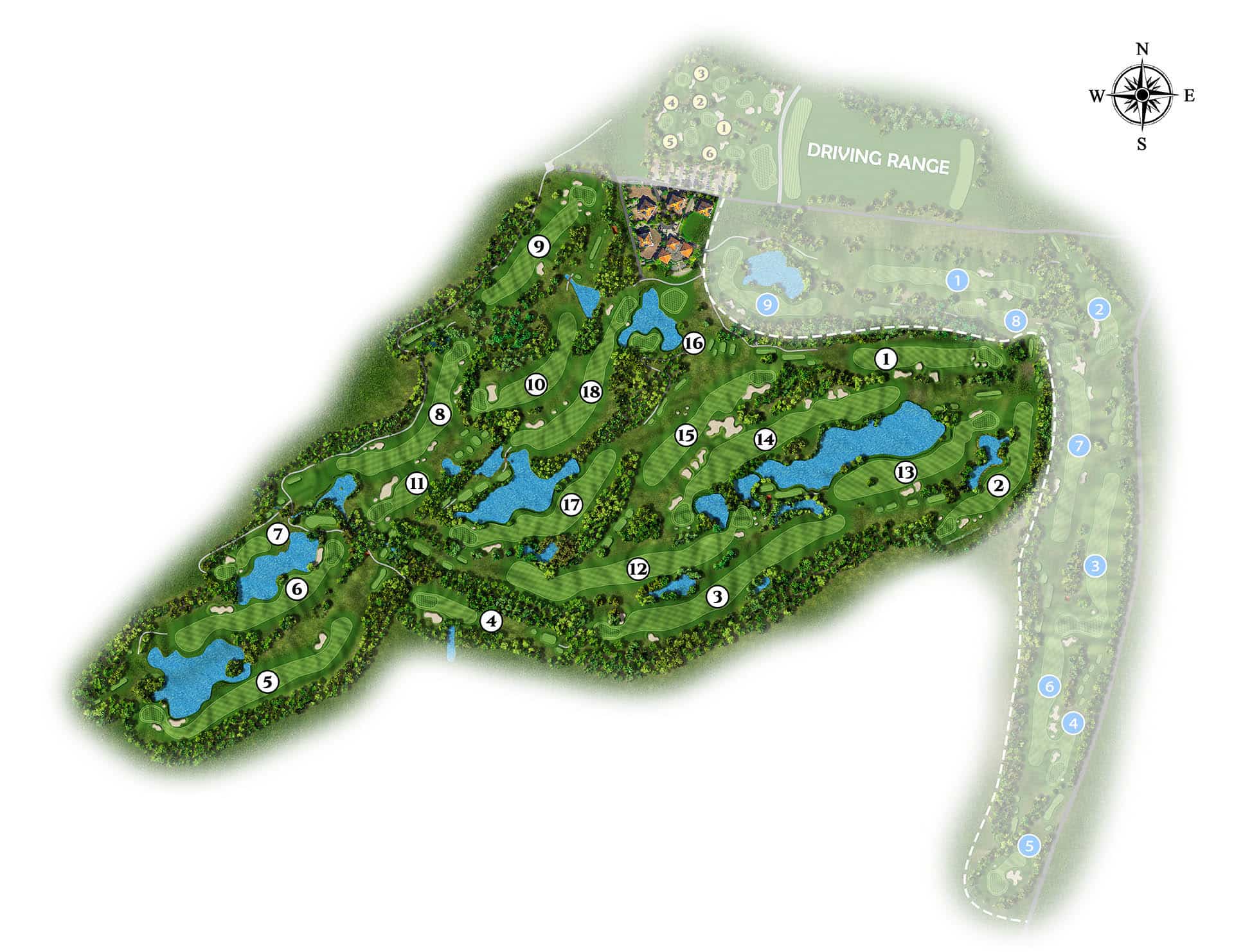
18 Holes – 14 lakes – Slope rating 142

Talking about Soufflenheim golf course in Alsace, Bernhard Langer said “a golf course designer only gets the chance to build a golf course in a place like this once in a lifetime.”
The natural landscape and existing infrastructure were ideal and just needed a light professional touch to turn them into an unequalled golfing site.
Enjoy the silence away from the bustle of everyday life in this delightful setting surrounded by forest, where 18 greens and 14 lakes blend harmoniously into grasslands that breathe calm and serenity.
The sensitivity deployed by Bernard Langer in integrating the course in this magnificent landscape has paid off, with a course that immediately inspires an immense feeling of relaxation.
The diversity and sheer beauty of the landscape and the experience of being surrounded by nothing but nature has become Soufflenheim’s brand image. Whether you are an ambitious competitive player or a youngster starting out in the game, you are sure to fall under Soufflenheim’s spell.
Our designed by Bernhard Langer championship course is ideal for all types of players and all types of competition.
The elaborate design of the greens means that this course can be played all year round on so-called “summer greens” (weather permitting of course).
It is accessible by golf cart, weather permitting.

Discover 18 HOLES

Click on the numbers (holes) for more information.

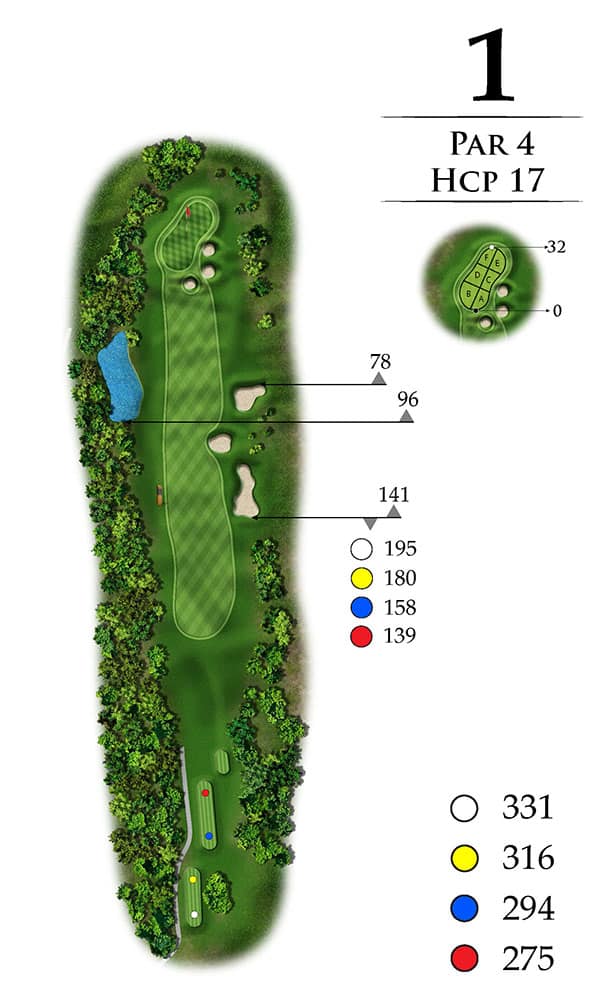
Hole n°1

The first tee is very clear with a wide fairway.

When teeing off, absolutely avoid passing the ball to the left next to the fairway, as it will be lost in many places in high bushes and water!

On the right, between 205 and 265 m after the start, you’ll find three hidden bunkers that you really need to pay attention to!

The flat green (35 m) is surrounded by three small but deep bunkers.

This is a very pleasant hole to start on.

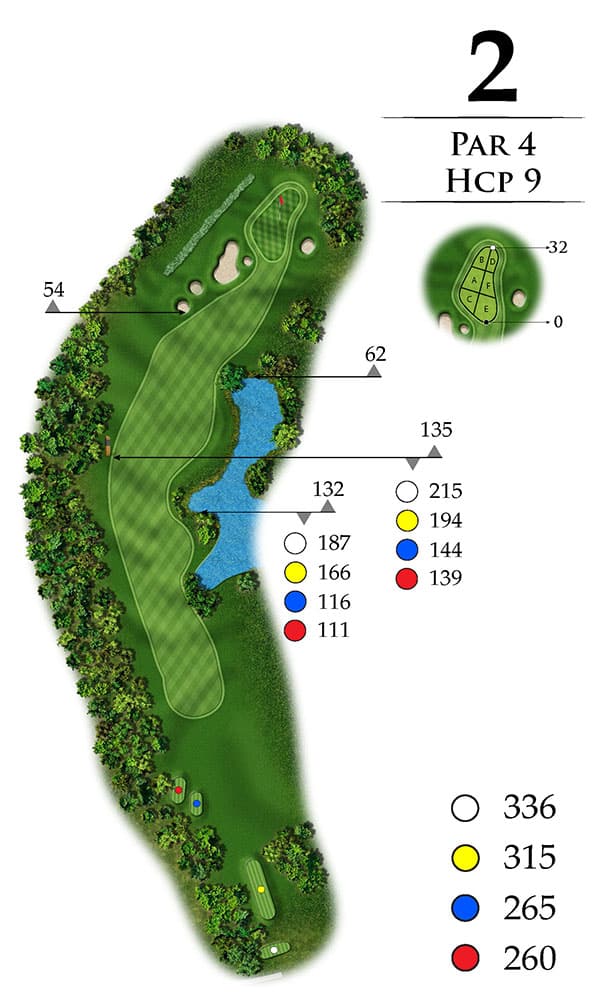
Hole n°2

The second hole is short, but requires a lot of experience.

Now the game gets harder!

Here, you need to deploy all your tactical reserves; a powerful start will do you no good.

It’s essential that your ball hits the fairway, otherwise it will disappear into a lake on the right (from 150 m) and a thick wood on the left.

From the fairway, you hit directly onto the green, which is surrounded by three strategically oriented bunkers.

The green (approx. 36 m) focuses on several levels. For this hole, it’s important to reach the right distance, otherwise you can expect a difficult putt.

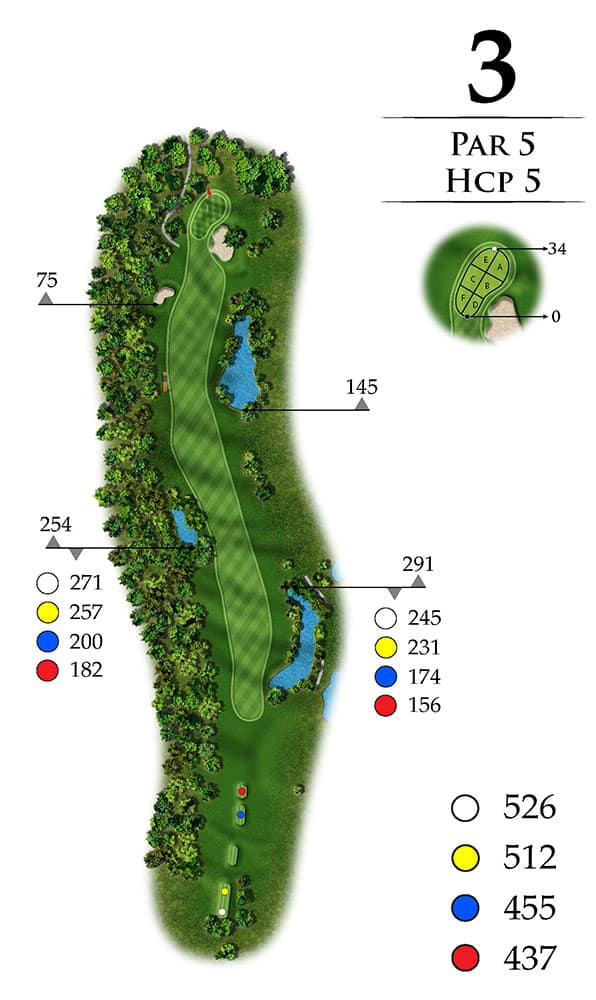
Hole no. 3

The third hole is played with a long drive (and that’s saying what it means…!).

Avoid the watering hole on the right (after the 170 m mark).

Position your second shot on the fairway so that you can place your third shot before the waterhole (150 m from the green) and play directly onto the green.

On the right, the green (37 m) is flanked by a large bunker and rises gently.

Good players are advised to make a long start. For the second shot, use a fairway wood so that the ball lands in a straight line to the water on the right.

A third short shot takes you to the green.

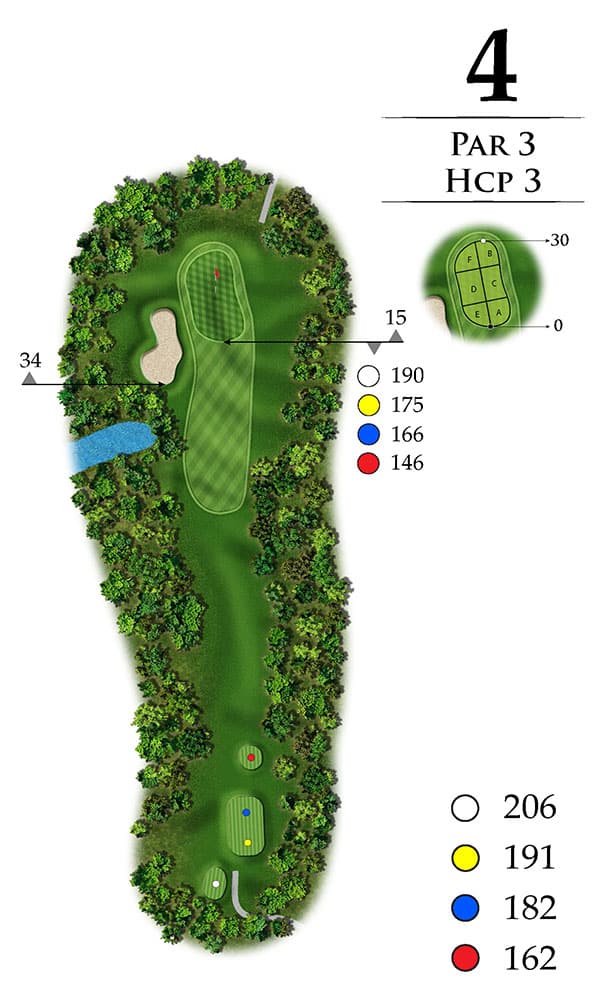
Hole n°4

The fourth hole is a long Par 3.

Because of its length, this Par 3 represents a challenge for golfers of all levels.

A straight start is required here, as the hole is bordered on both sides by dense forest.

A large bunker defends the green on the left.

In the front part, the green is at the same height as the fairway (12 m), but flattens out further out. Here, for both the approach shot and the putt, distance control is very important.

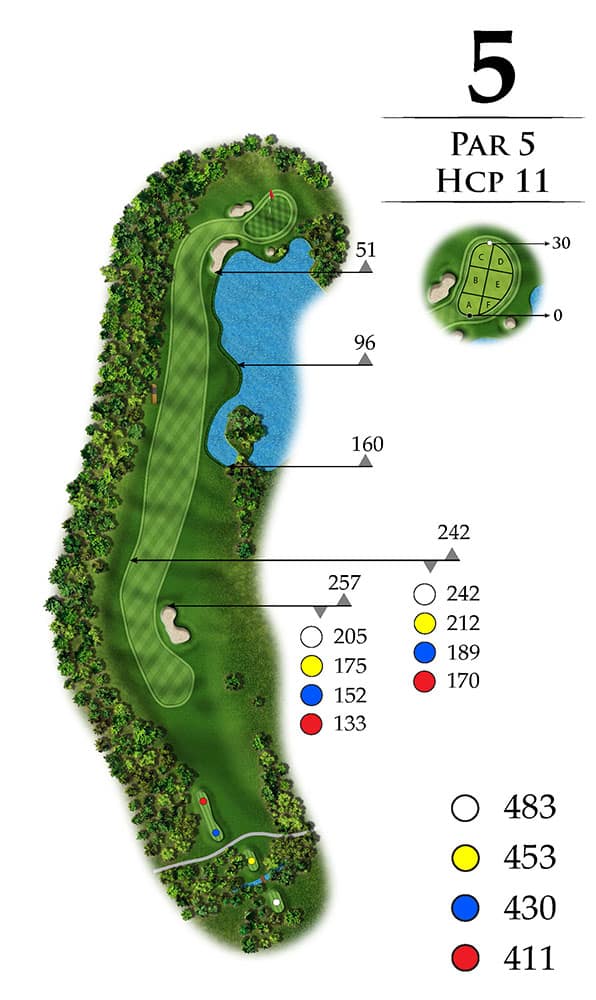
Hole 5

The Fifth offers you a choice: do you take a chance or do you play it safe?

You could land your tee short on the broad section of the fairway near the bunker on the right – that’s the safe way – or you could try to hit it over the bunker and risk ending up in the sand or in the rough.

Your second shot should be relatively long or you’ll have to play over the water.

The problem is that the fairway gets narrower the further you go down it.

Keep your nerve if you play over the water onto the green, or it’ll cost you a ball. Or three.

The green (35m) is broad with a lot of unevenness that makes your putt all the more difficult.

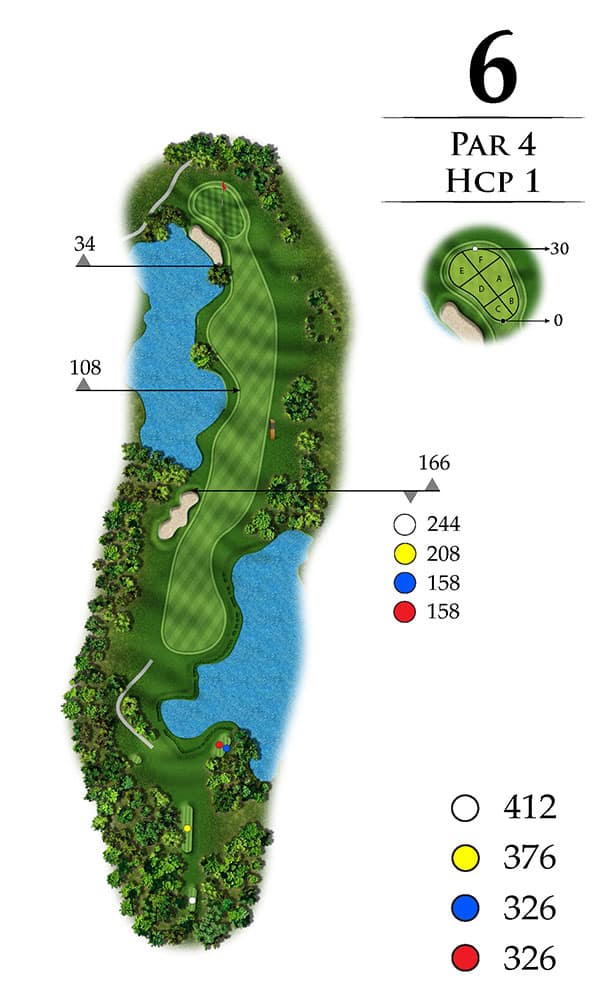
Hole 6

Now you’re on the most challenging hole on the course.

Just stay calm and play it safe. And keep away from the water on the right.

Try to hit your shot to 140m – 200m out on the left-hand side of the fairway, so that the ball comes to rest just in front of the bunker (starts at 220m).

Your second shot should go up the right-hand side of the fairway so that it avoids the big tree on the left.

A straight shot with a short iron will take the ball onto the green.

The green itself is flat and about 32m long. Watch for the bunker in front and to the left of it.

A tip for very good golfers: try hitting your tee shot about 230m over the water, so that you can use a medium iron to get onto the green.

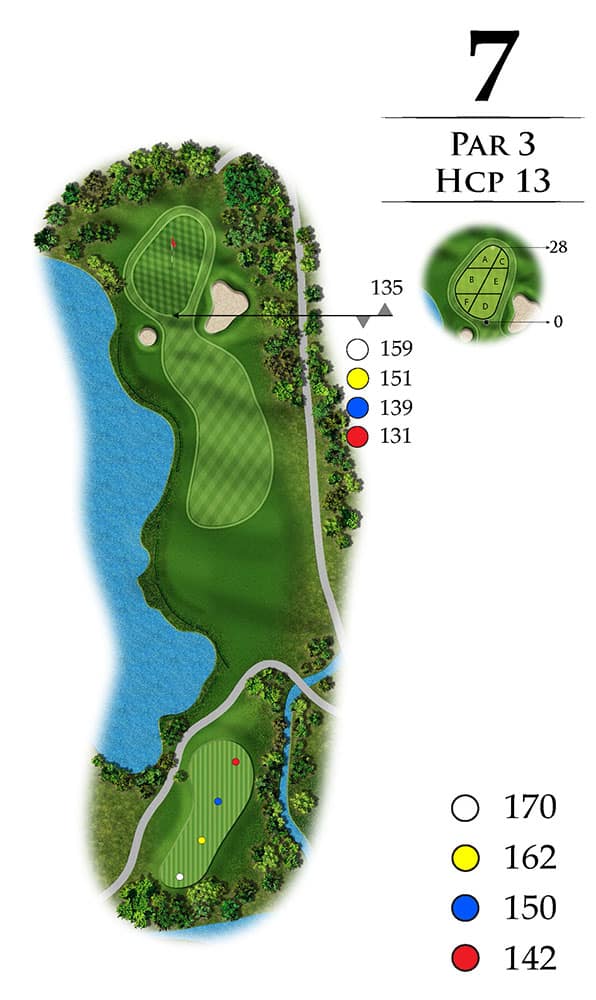
Hole 7

This is a very scenic hole, but it still demands respect.

You can play down the right-hand side of the fairway and land just in front of the bunker, avoiding the water on the left.

Then it’s just a straightforward pitch over the bunker and onto the green.

Or you can risk it and hit a long straight drive to land between bunker and green.

The green (28m) rises slightly towards the back.

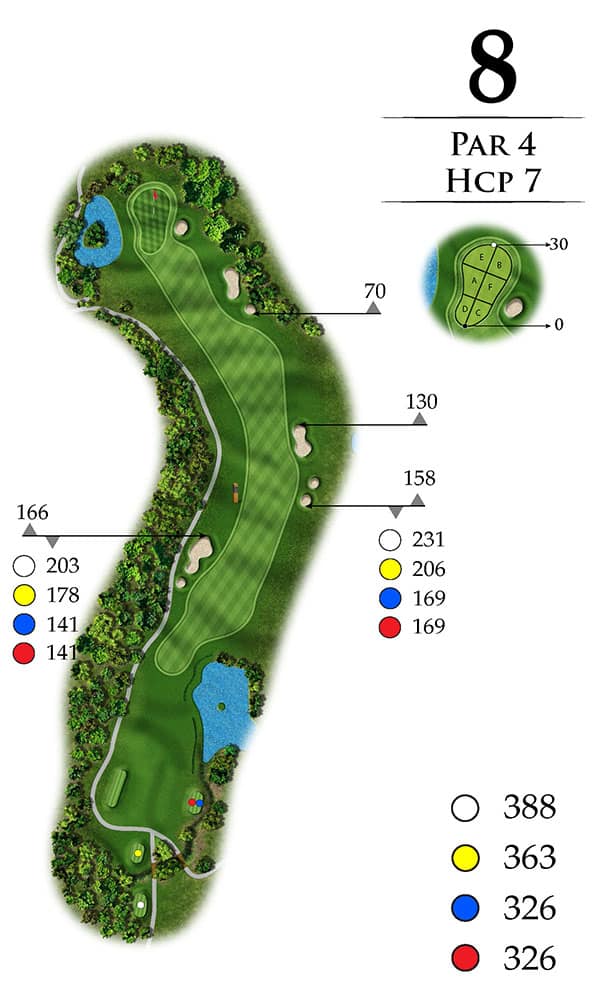
Hole 8

The Eighth is the first dog-leg on the course.

To the left of the fairway is out of bounds, so hit your tee shot centre-right of the fairway.

The next shot should be used to find the fairway so that the shot afterwards reaches the green.

On the right-hand side of the second half of the fairway lie six bunkers which are very well hidden and difficult to spot.

More advanced players should hit their tee shot so far that they don’t have to search for the fairway and can play a medium iron onto the green.

The green (32m) is slightly uneven and rises towards the back. There’s a small bunker in front and to the right of it.

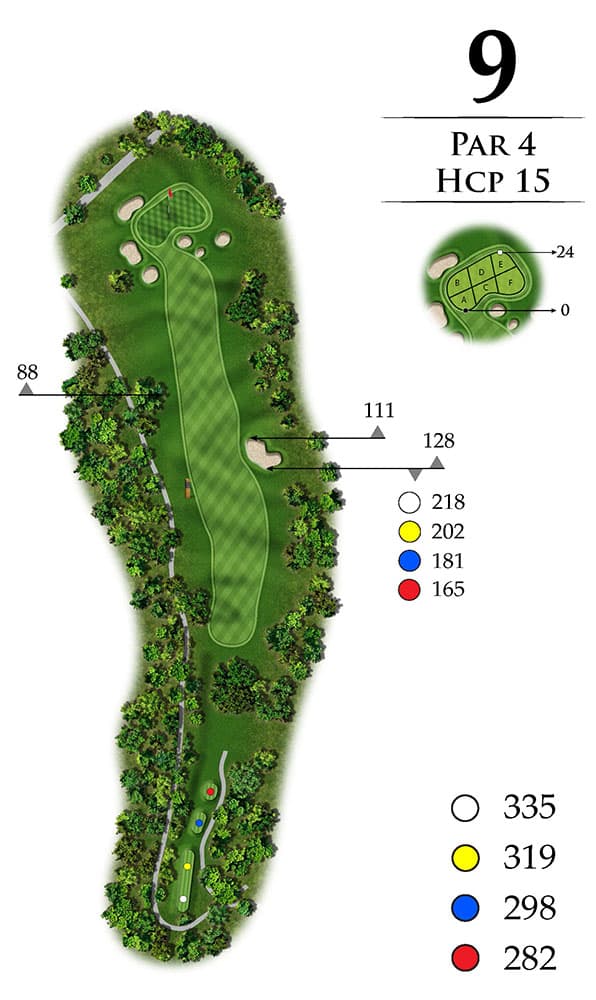
Hole 9

The Ninth curves gently to the left, and to the left of it is out of bounds.

Play down the right to a land in front of the bunker.

The tee shot can be 150m – 200m long, as the bunker is at the 220m mark.

The next shot should be played from there straight towards the green, but should come to rest about 40m before it, as there are six bunkers arranged around the front.

The green is flat and plateau-like, and only ca. 22 m long, but is quite broad.

A tip for very good players: put your tee shot to the left of the bunker.

Draw the shot from right to left to avoid the trees on the left-hand side.

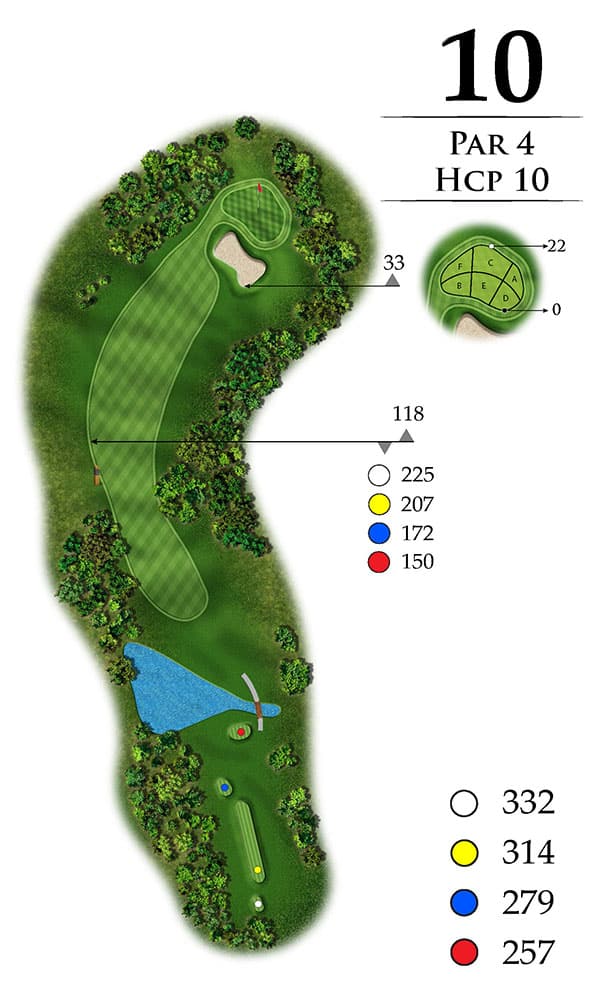
Hole 10

This is a relatively short hole, with a dog-leg right.

There’s a biotope on the left. Hit a straight drive of 200m or more so that you reach the green with your second shot.

If you hit shorter, you’ll have problems with the trees on the right.

If you drive less than 200m, you’d be well-advised to keep left.

Your second shot should clear the large bunker guarding the plateau green.

If you’ve hit less than 200m, you can play round to the left of the bunker and then try to get onto the green with a short pitch.

The green is broad and short (24m) with slight hillocks.

A tip from the pro: Never land in the bunker!

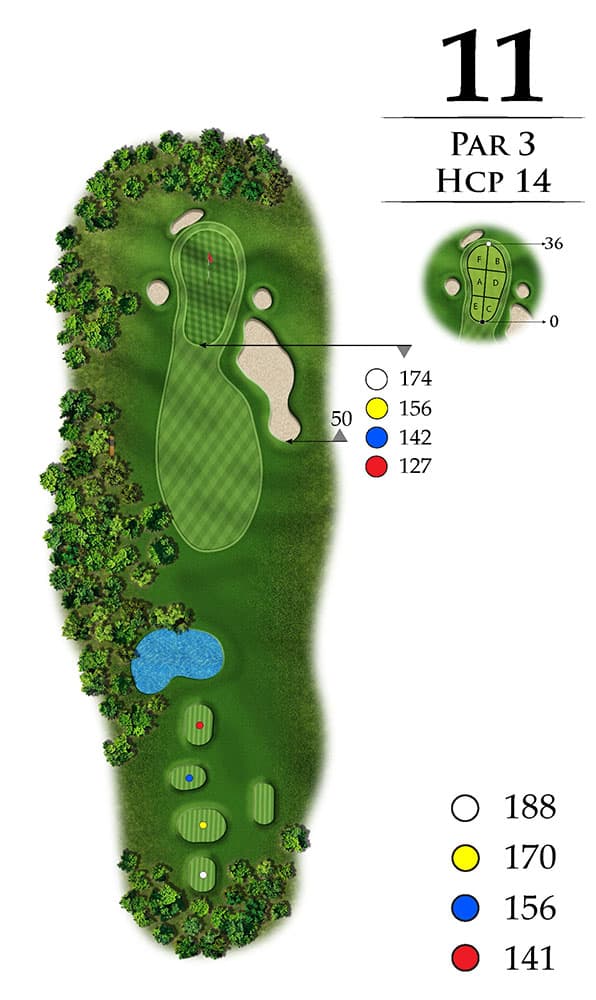
Hole 11

A nice par 3, to be played with a gentle touch.

On the left are small waterfalls; it’s pretty but you should still keep your ball out of it.

The green is narrow, but very long (38m) and relatively flat.

There’s a large fairway bunker on the right and three pot bunkers around the green.

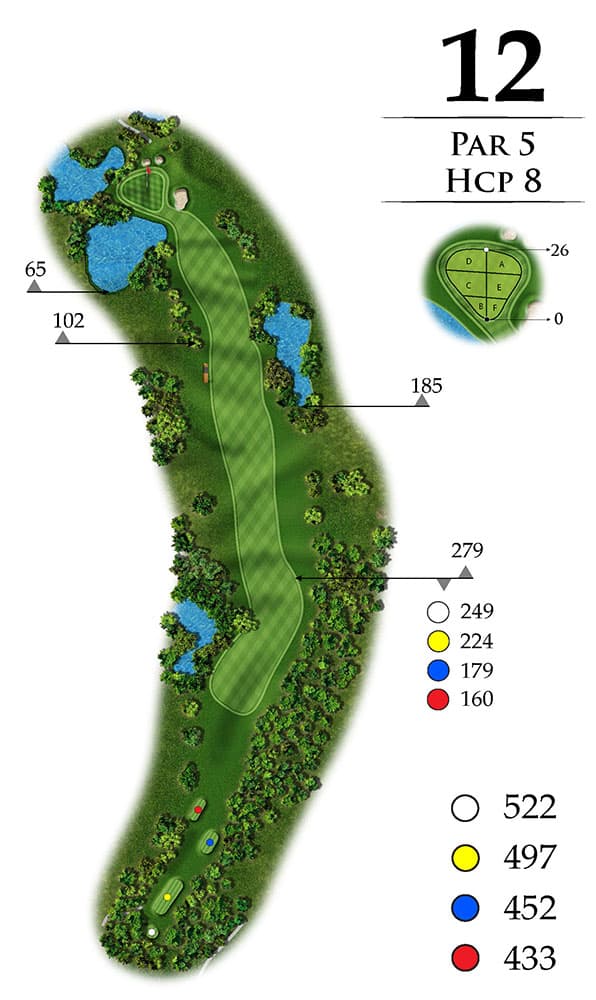
Hole 12

This is a long and curved hole, with a dog-leg to the left.

The Fairway is broad but, if you do manage to miss it, there’s water waiting to the left and trees to the right.

So you should try to put it down the middle.

Go for maximum length with your second shot, there’s no real risk of getting into difficulty.

The third shot should go down the right-hand side of the fairway, to keep away from the water on the left.

The next shot should be an accurate pitch onto the green, avoiding the water to the left and behind the green, and the bunkers behind and to the right.

The undulating green is 29m long and about as broad.

Top players can try to cut the dog-leg to shorten the hole – keep away from the trees and the water.

The carefully hit second shot finds the middle of the fairway about 80m in front of the green.

The green shot goes right over the middle of the water.

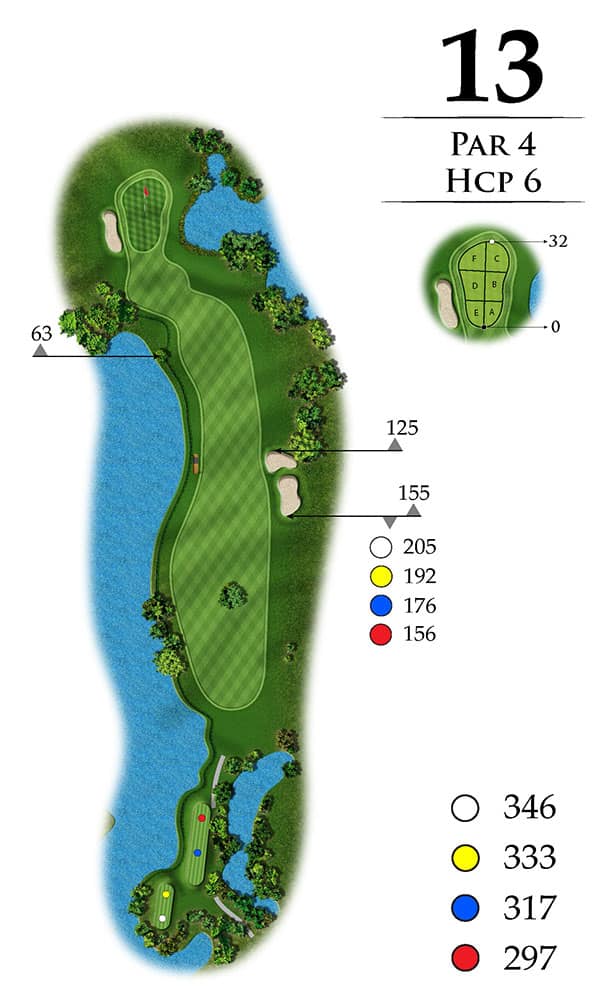
Hole 13

This is the first hole beside a large lake!

Make sure your tee shot keeps right, or there will be a splash.

You can play either left or right of the big tree.

To the right is safer, but you’ll get more length if you go left.

Try to hit your second shot so that it comes to rest in front of the lake on the right.

From there, your approach shot goes over the water and onto the left-hand side of the flat green (34m long).

A good player will hit the tee shot to land near the bunker in half-way down the fairway.

From here you can play the ball down the corridor between the two lakes and onto the green.

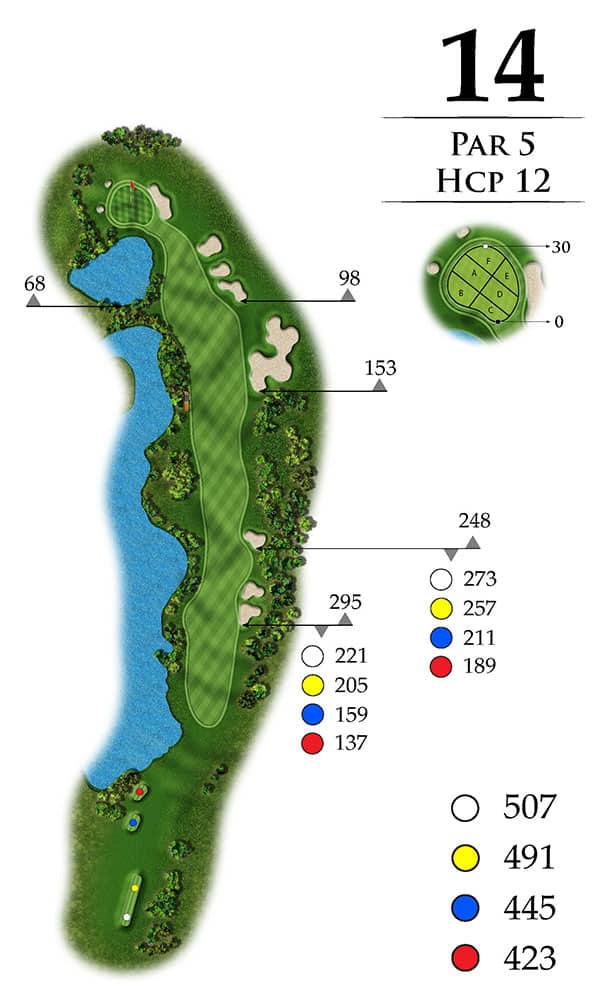
Hole 14

Now you’re on the other side of the water you’ve just played.

Try to keep your tee shot away from the water on the left and put the ball on the right.

Play the bunkers strategically – try to play them safely, and you could end up in one.

The second shot is like the first, as there are bunkers on the right and water on the left here too – but the fairway is nice and broad.

The third shot puts the ball near the green, so that the next shot puts you on the green (28m long and wide).

The green is surrounded by four bunkers.

Good golfers should be able to hit their tee shot to next to the bunkers, and then play a fairway wood to get to within about 120m of the green.

The next shot finds the middle of the green, leaving a short putt to finish the hole.

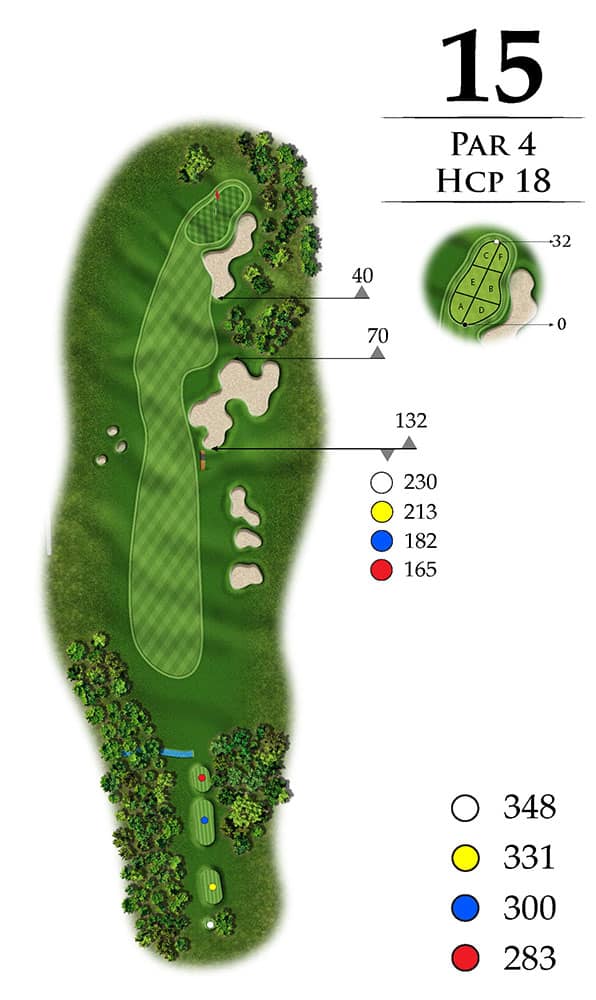
Hole 15

This hole seems to be the easiest on the course.

The drive down the open fairway is the beginning.

But watch for the bunkers bordering the right-hand side.

The second shot reaches the long (34m) but very narrow green with the imposing bunker on the right.

The shot should tend to the left so that the ball doesn’t end up in the sand.

The green is the most challenging on the course, so be very careful!

Enjoy this hole – you’ll find the final three on the course really challenge you again.

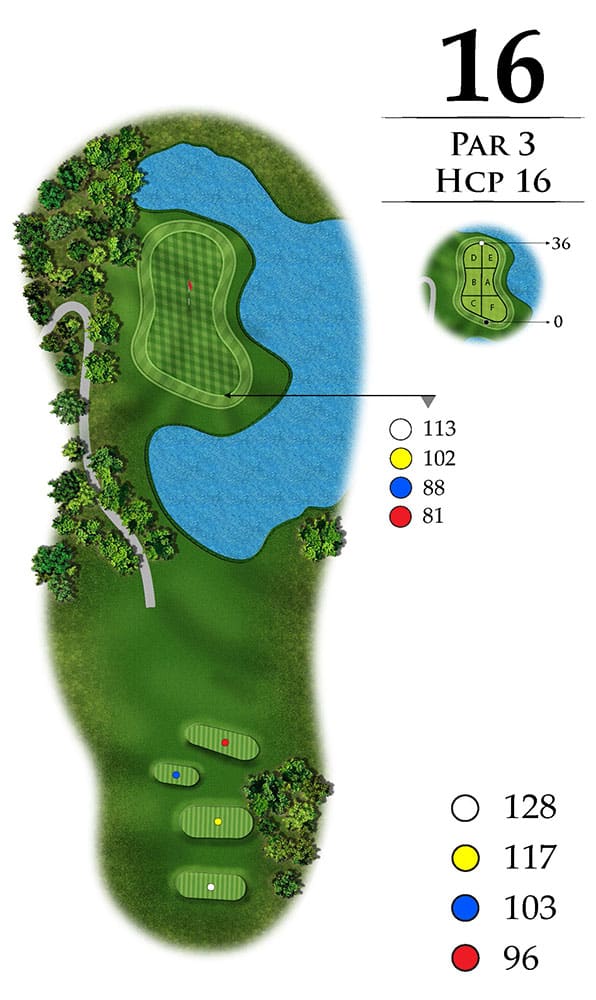
Hole 16

The Sixteenth is the shortest in the round – ideal for a hole-in-one!

The idea is as simple as it could be: one straight shot (ca. 120m).

If you don’t get it right, there are four places the ball could end up; three of them are watery. And the fourth is the trees on the left.

But don’t worry, you’re not alone – the whole clubhouse is watching fascinated from the terrace!

The green is 37m and undulates. If you find the right distance on the green, it’ll help your putt enormously.

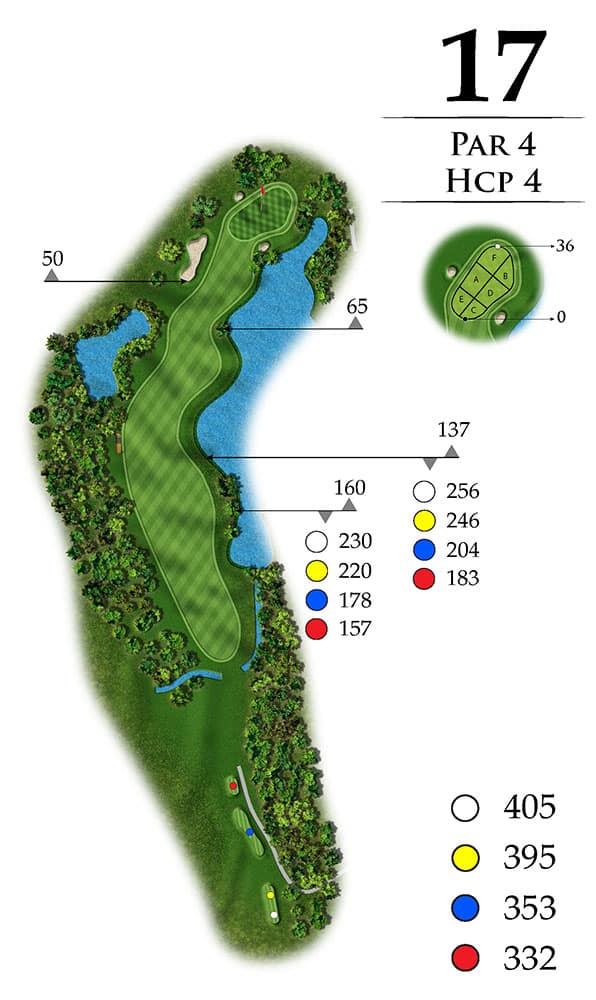
Hole 17

How are your nerves? You’ll need them here again.

A long, arrow-straight drive off the tee is the best way to start here.

Play too far to the left and the ball disappears into the trees. Too far to the right and it goes into the water.

When you’ve managed to find the fairway, the second, accurate shot continues down it.

If you miss the fairway now, the ball is bound to splash into one of the lakes on either side.

The third shot puts you on the green (35m long), which is flat but is also flanked by two bunkers.

Good players should place their tee shot in the middle of the fairway, so that the iron shot next finds the green.

Think positive!

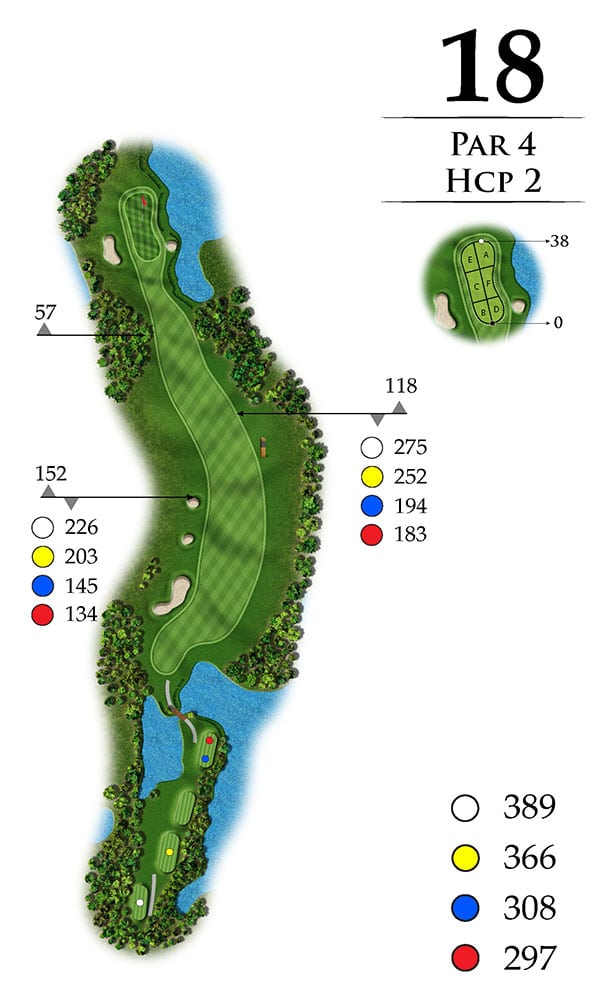
Hole 18

Last but not least – one last effort before you can relax in the Nineteenth.

The fairway is invitingly broad.

There’s just the small matter of 130m over water to get there…

Hit your second shot to 70m in front of the green, the fairway gets too narrow after that.

Your third, very accurate shot puts you on the green, which is very long and extremely narrow.

There’s water on the right, so it’s a good idea to aim slightly left – watch out for the bunkers left and right in front of the green.

Field information

Golf Webcam

Webcam Golf Club Soufflenheim

Today's entry requirements

18-hole course :

Ouvert

9-hole course :

Ouvert

6-hole course :

Ouvert

Carts allowed :

Oui

Authorized trolleys :

Oui

Information
Golf & Restaurant

The Golf Reception is open every day

Opening hours:
Monday to Sunday | 8. AM – 6 PM

You can contact us:
info@golfclub-soufflenheim.com
+33 (0)3 88 05 77 00

Weather for the next 7 days

Hole n°1

The first tee is very clear with a wide fairway.

When teeing off, absolutely avoid passing the ball to the left next to the fairway, as it will be lost in many places in high bushes and water!

On the right, between 205 and 265 m after the start, you’ll find three hidden bunkers that you really need to pay attention to!

The flat green (35 m) is surrounded by three small but deep bunkers.

This is a very pleasant hole to start on.

Hole n°2

The second hole is short, but requires a lot of experience.

Now the game gets harder!

Here, you need to deploy all your tactical reserves; a powerful start will do you no good.

It’s essential that your ball hits the fairway, otherwise it will disappear into a lake on the right (from 150 m) and a thick wood on the left.

From the fairway, you hit directly onto the green, which is surrounded by three strategically oriented bunkers.

The green (approx. 36 m) focuses on several levels. For this hole, it’s important to reach the right distance, otherwise you can expect a difficult putt.

Hole no. 3

The third hole is played with a long drive (and that’s saying what it means…!).

Avoid the watering hole on the right (after the 170 m mark).

Position your second shot on the fairway so that you can place your third shot before the waterhole (150 m from the green) and play directly onto the green.

On the right, the green (37 m) is flanked by a large bunker and rises gently.

Good players are advised to make a long start. For the second shot, use a fairway wood so that the ball lands in a straight line to the water on the right.

A third short shot takes you to the green.

Hole n°4

The fourth hole is a long Par 3.

Because of its length, this Par 3 represents a challenge for golfers of all levels.

A straight start is required here, as the hole is bordered on both sides by dense forest.

A large bunker defends the green on the left.

In the front part, the green is at the same height as the fairway (12 m), but flattens out further out. Here, for both the approach shot and the putt, distance control is very important.

Hole 5

The Fifth offers you a choice: do you take a chance or do you play it safe?

You could land your tee short on the broad section of the fairway near the bunker on the right – that’s the safe way – or you could try to hit it over the bunker and risk ending up in the sand or in the rough.

Your second shot should be relatively long or you’ll have to play over the water.

The problem is that the fairway gets narrower the further you go down it.

Keep your nerve if you play over the water onto the green, or it’ll cost you a ball. Or three.

The green (35m) is broad with a lot of unevenness that makes your putt all the more difficult.

Hole 6

Now you’re on the most challenging hole on the course.

Just stay calm and play it safe. And keep away from the water on the right.

Try to hit your shot to 140m – 200m out on the left-hand side of the fairway, so that the ball comes to rest just in front of the bunker (starts at 220m).

Your second shot should go up the right-hand side of the fairway so that it avoids the big tree on the left.

A straight shot with a short iron will take the ball onto the green.

The green itself is flat and about 32m long. Watch for the bunker in front and to the left of it.

A tip for very good golfers: try hitting your tee shot about 230m over the water, so that you can use a medium iron to get onto the green.

Hole 7

This is a very scenic hole, but it still demands respect.

You can play down the right-hand side of the fairway and land just in front of the bunker, avoiding the water on the left.

Then it’s just a straightforward pitch over the bunker and onto the green.

Or you can risk it and hit a long straight drive to land between bunker and green.

The green (28m) rises slightly towards the back.

Hole 8

The Eighth is the first dog-leg on the course.

To the left of the fairway is out of bounds, so hit your tee shot centre-right of the fairway.

The next shot should be used to find the fairway so that the shot afterwards reaches the green.

On the right-hand side of the second half of the fairway lie six bunkers which are very well hidden and difficult to spot.

More advanced players should hit their tee shot so far that they don’t have to search for the fairway and can play a medium iron onto the green.

The green (32m) is slightly uneven and rises towards the back. There’s a small bunker in front and to the right of it.

Hole 9

The Ninth curves gently to the left, and to the left of it is out of bounds.

Play down the right to a land in front of the bunker.

The tee shot can be 150m – 200m long, as the bunker is at the 220m mark.

The next shot should be played from there straight towards the green, but should come to rest about 40m before it, as there are six bunkers arranged around the front.

The green is flat and plateau-like, and only ca. 22 m long, but is quite broad.

A tip for very good players: put your tee shot to the left of the bunker.

Draw the shot from right to left to avoid the trees on the left-hand side.

Hole 10

This is a relatively short hole, with a dog-leg right.

There’s a biotope on the left. Hit a straight drive of 200m or more so that you reach the green with your second shot.

If you hit shorter, you’ll have problems with the trees on the right.

If you drive less than 200m, you’d be well-advised to keep left.

Your second shot should clear the large bunker guarding the plateau green.

If you’ve hit less than 200m, you can play round to the left of the bunker and then try to get onto the green with a short pitch.

The green is broad and short (24m) with slight hillocks.

A tip from the pro: Never land in the bunker!

Hole 11

A nice par 3, to be played with a gentle touch.

On the left are small waterfalls; it’s pretty but you should still keep your ball out of it.

The green is narrow, but very long (38m) and relatively flat.

There’s a large fairway bunker on the right and three pot bunkers around the green.

Hole 12

This is a long and curved hole, with a dog-leg to the left.

The Fairway is broad but, if you do manage to miss it, there’s water waiting to the left and trees to the right.

So you should try to put it down the middle.

Go for maximum length with your second shot, there’s no real risk of getting into difficulty.

The third shot should go down the right-hand side of the fairway, to keep away from the water on the left.

The next shot should be an accurate pitch onto the green, avoiding the water to the left and behind the green, and the bunkers behind and to the right.

The undulating green is 29m long and about as broad.

Top players can try to cut the dog-leg to shorten the hole – keep away from the trees and the water.

The carefully hit second shot finds the middle of the fairway about 80m in front of the green.

The green shot goes right over the middle of the water.

Hole 13

This is the first hole beside a large lake!

Make sure your tee shot keeps right, or there will be a splash.

You can play either left or right of the big tree.

To the right is safer, but you’ll get more length if you go left.

Try to hit your second shot so that it comes to rest in front of the lake on the right.

From there, your approach shot goes over the water and onto the left-hand side of the flat green (34m long).

A good player will hit the tee shot to land near the bunker in half-way down the fairway.

From here you can play the ball down the corridor between the two lakes and onto the green.

Hole 14

Now you’re on the other side of the water you’ve just played.

Try to keep your tee shot away from the water on the left and put the ball on the right.

Play the bunkers strategically – try to play them safely, and you could end up in one.

The second shot is like the first, as there are bunkers on the right and water on the left here too – but the fairway is nice and broad.

The third shot puts the ball near the green, so that the next shot puts you on the green (28m long and wide).

The green is surrounded by four bunkers.

Good golfers should be able to hit their tee shot to next to the bunkers, and then play a fairway wood to get to within about 120m of the green.

The next shot finds the middle of the green, leaving a short putt to finish the hole.

Hole 15

This hole seems to be the easiest on the course.

The drive down the open fairway is the beginning.

But watch for the bunkers bordering the right-hand side.

The second shot reaches the long (34m) but very narrow green with the imposing bunker on the right.

The shot should tend to the left so that the ball doesn’t end up in the sand.

The green is the most challenging on the course, so be very careful!

Enjoy this hole – you’ll find the final three on the course really challenge you again.

Hole 16

The Sixteenth is the shortest in the round – ideal for a hole-in-one!

The idea is as simple as it could be: one straight shot (ca. 120m).

If you don’t get it right, there are four places the ball could end up; three of them are watery. And the fourth is the trees on the left.

But don’t worry, you’re not alone – the whole clubhouse is watching fascinated from the terrace!

The green is 37m and undulates. If you find the right distance on the green, it’ll help your putt enormously.

Hole 17

How are your nerves? You’ll need them here again.

A long, arrow-straight drive off the tee is the best way to start here.

Play too far to the left and the ball disappears into the trees. Too far to the right and it goes into the water.

When you’ve managed to find the fairway, the second, accurate shot continues down it.

If you miss the fairway now, the ball is bound to splash into one of the lakes on either side.

The third shot puts you on the green (35m long), which is flat but is also flanked by two bunkers.

Good players should place their tee shot in the middle of the fairway, so that the iron shot next finds the green.

Think positive!

Hole 18

Last but not least – one last effort before you can relax in the Nineteenth.

The fairway is invitingly broad.

There’s just the small matter of 130m over water to get there…

Hit your second shot to 70m in front of the green, the fairway gets too narrow after that.

Your third, very accurate shot puts you on the green, which is very long and extremely narrow.

There’s water on the right, so it’s a good idea to aim slightly left – watch out for the bunkers left and right in front of the green.

Field information

Golf Webcam

Webcam Golf Club Soufflenheim

Today's entry requirements

18-hole course :

Ouvert

9-hole course :

Ouvert

6-hole course :

Ouvert

Carts allowed :

Oui

Authorized trolleys :

Oui

Information
Golf & Restaurant

The Golf Reception is open every day

Opening hours:
Monday to Sunday | 8. AM – 6 PM

You can contact us:
info@golfclub-soufflenheim.com
+33 (0)3 88 05 77 00

Weather for the next 7 days

Contact us